There are a few reasons why I take hagiographies with a pinch of salt. Nay! a lot of it even at the cost of blood pressure from it down the lane.
Here’s one more such episode.
hastigirinātar aṇṇan, better known as prativādi bhayaṃkaraṃ aṇṇā [1], to some was a śiṣya of both swāmi deśikan and maṇavāḷamāmunigaḷ. Thankfully, just a minority and not the mainstream opinion.
Let us unpack a few layers here.
First, the rather obvious and non-technical one of timelines. aṇṇan, by the CE timelines, was born in 1361 and in 1369, when swāmi deśikan attained paramapadam, would have been all of 8 years.
An age where he could just about have started with śruti proper, so that being a precursor in that age for vedāntaśravaṇa, could not have been a deśika śiṣya at any stretch.
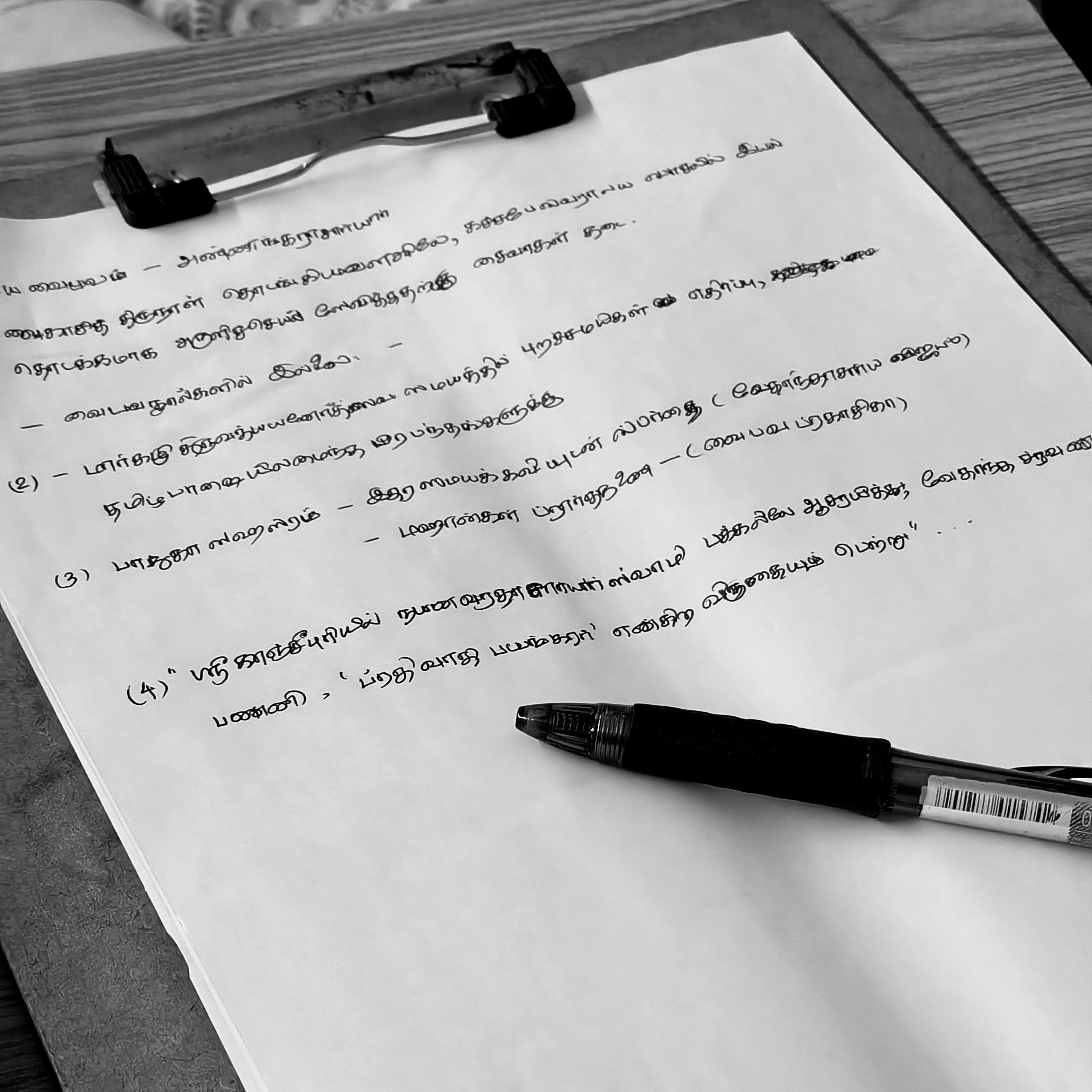
Second, prativādi bhayaṃkaraṃ aṇṇaṅgarācārya of kāñci of the current age (read, the last century or so), in his work pūrvācārya vaibhava acknowledges his being a śiṣya or nayanavaradācāraya, the kumāra of swāmi deśikan.
One might want sound holier than the pope or royalist than the king himself, but that’s a problem.
So, by logic and by admission, one has to then ascribe a clear connection only to swāmi deśīkan’s putra, and not himself.
We would be fine if we grazed the top layers only, but alas! there lies more below, that one asks.
His taniyan goes, as follows.
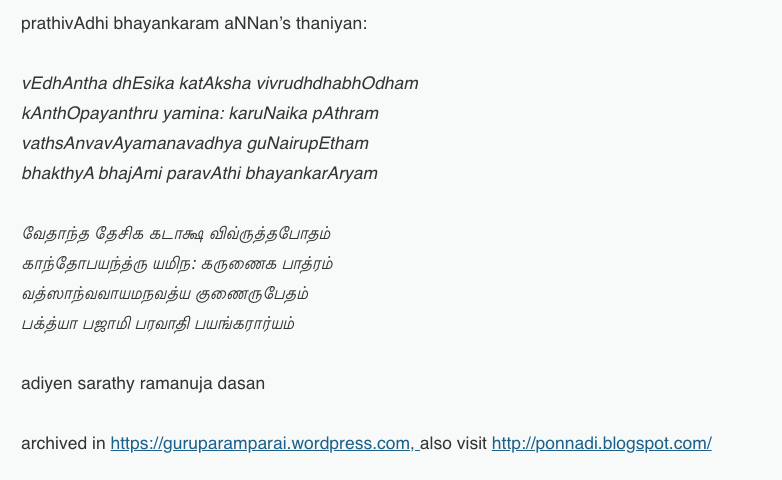
Here is the uncomfortable question. If there exists no connection to swāmi deśikan, except insofar as a connection through his son, how does the first line fit in?
Yes, one might want to answer that by roping in the episode from swāmi deśīkan’s own carita as a parallel.
An episode where swāmi deśikan’s prācāraya (ācārya's ācārya; kiḍāmbi appuḷḷār's ācārya naḍādūr ammāḷ) blesses him when he was much younger than an age for upanayana.
But then, such an episode is lacking in any extant vaibhavagranthas pertaining to hastigirināthar aṇṇan.
That leaves us to ask yet another question of discomfort — how was this taniyan tampered then and how is it extant without question?
While this is by no means an original question (coming from my ācāryan), some cross referencing to build the case as it were, is the only original addition if it might even be called that.
Going back, the hypothesis since there exist no antithesis, around the taniyan and the layering, is that it is but a lazy assimilation of an existing one.
For some, this might sound way too fantastic. Especially when one posits a hypothesis that the original taniyan only spoke of nayanavaradācārya in the first two lines.
The reasoning might be, “two lines talking of one’s ācāryan while the taniyan is not of his.”
It might sound fair, until one is reminded of the taniyans of parāṅkuśa rāmānuja yatīndra mahādeśikan (24th paṭṭaṁ aźagiyasiṅgar), nārāyaṇa yatīndra mahādeśikan (22nd paṭṭaṁ aźagiyasiṅgar) as taniyans that have a similar theme.
With those uncomfortable questions left to the analysts to get to, we would like to draw attention to something that our school at large has been seeing the wrong way for a while now.
The greatness all these ācāryapuruṣas have is innate and does not need to be buffed up with grandiose claims.
aṇṇan’s suprabhāta is nirvivādāspadaṁ a recitation and testament to his bhakti.
swāmi deśikan’s happiness lies in “oronṛu tānē amaiyādō,” not in grand shows of swarṇa. Irony too, considering how he treated swarṇa within his own jīvyakāla.
So, a bit more nuanced to put it, a major shift of focus from the outside to the inside is what we need.
As the kaṭha goes, “parāñci khāni vyatṛṇatsvayambhū”, start small, perhaps, to find a way in this maddening space.